Phase 5 Appendix
This, which I call Appendix, is selected text from the book by Arthur Pauls, The Philosophy and History of Ortho-Bionomy, 2nd revised edition. From Chapter Six,
The Seven Phases of Ortho-Bionomy
pages 41-46.
Available through the Society of Ortho-Bionomy International.
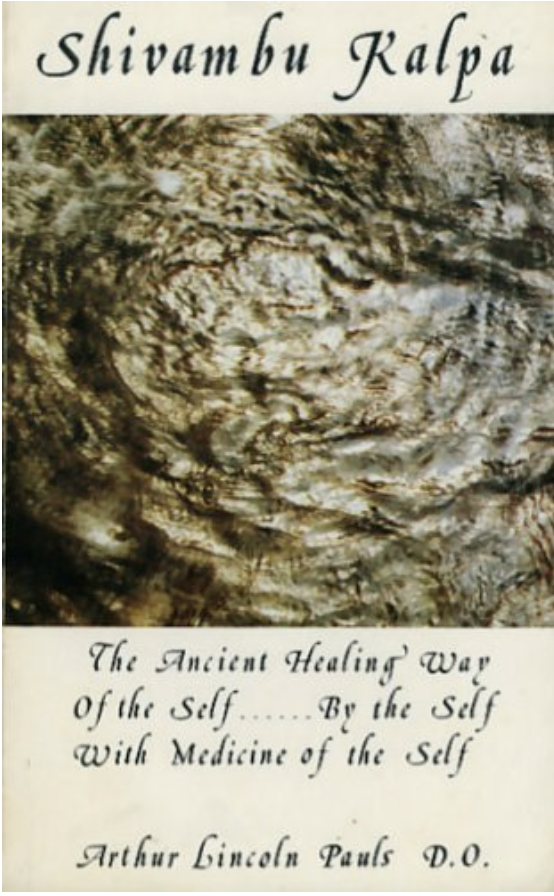
Shivambu Kalpa: The Ancient Healing Way of th Self . . . . . . .By the Self with Medicine of the Self
Apparently one can purchase a copy through Amazon, beginning at $323.19. Not worth that unless you are an investoer in rare books. It is now available to read for free through Internet Archives.
The book is about auto urine therapy but it contains a chapter on Ortho-Bionomy. Here is how he described Phase Five (page 86):
This is a breakaway from the original concept. Instead of the 'operator' connecting the patient, the patients bring about their own correction by directing the operator's hands, by a mentally patterned proprioceptive neuro-etheric muscular reflex. This may sound complex but in fact it is very simple to teach to anyone with a necessary understanding of energy.
Shivambu Kalpa: The Ancient Healing Way of th Self . . . . . . .By the Self with Medicine of the Self
Occasionally a copy may be found on sites like Amazon, for exorbitant prices. It's worth that unless you are a collector of rare books. It is available to read for free through Internet Archives.
The book is about auto urine therapy (a practice I am not a fan of and do not recommend, but chacun à son goût. It contains a worthwhile chapter on Ortho-Bionomy. Here is how he described Phase Five (page 86):
This is a breakaway from the original concept. Instead of the 'operator' connecting the patient, the patients bring about their own correction by directing the operator's hands, by a mentally patterned proprioceptive neuro-etheric muscular reflex. This may sound complex but in fact it is very simple to teach to anyone with a necessary understanding of energy.
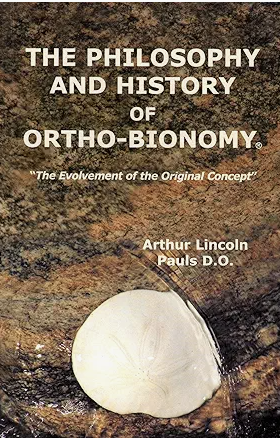
Copyright 2002. This book was published posthumously, his last words, so to speak. This edition is out of print. It can sometimes be found on sites like Amazon. I've seen it for as high as $1000 there.
<< New image with text >>
Not Just for Fun: Phase 2, Phase 3, and the Architecture of Possibility
Appendix: From "The Philosophy and History of Ortho-Bionomy" (revised edition)
by Arthur Lincoln Pauls
Phase One
Examine the trigger points as listed for each specific area. Let's choose one to seven in the cervical region. With the client in supine position, pick a trigger. Don't forget that there are also anterior triggers as well as posterior. Press the trigger points gently and the client will usually confirm tenderness there. Now, move the head in different directions until both you and the client have agreed that it feels the best it can in that position. Look at the clock on the wall. Hold the head for exactly 90 seconds, being careful not to change the position. When the time is up, very slowly move the head back to the neutral starting place. Re-examine the trigger point. The tenderness will have decreased or disappeared if you were successful in the positioning confirmed by you and your client. Congratulations! You have performed all the necessary requirements of a scientific mind that demands to know what it is doing. Do all your work like this and it will stay as work. It will also keep you at Square One. Like a chess game, real life may start from a limited number of initial positions, but from there the variety of possible moves are infinite. But don't worry: many of the things done in this world are taught at Square One level. You will have endless friends who join Square One clubs and who enjoy their work. Square One is a safe place to be. It is a framework that gives you room to move, so long as you stay in the confinement of the square. If you are daring enough, you can join the Enclosed-Round club, running around in circles and wonder why you are going nowhere. One day, however, you may want nothing less than to launch yourself into space.
Phase Two
Observation: I keep hearing the same words screaming in my ear while I am doing Phase One—Boring!! Boring! BORING!!! Why? Why always three times? Why? Why?? Why??? Can't we turn work into play? Maybe there would be some fun! Fun!! FUN!!! in it. But the idea is childish. Who would seriously listen to a child?
Wait a minute! Didn't a childish mind once call the Founder of Ortho-Bionomy "the Flounder"? And didn't that Flounder (a type of bottom-feeding fish) state that the best student of Ortho-Bionomy would be a seven-year-old child who knew NOTHING?
I got it! I'll play around with the idea of less time. I'll only hold a position for 60 seconds. Maybe I'll even just close my eyes and pretend I can guess the right time. Sounds crazy and unscientific. Wait a minute! Doesn't the word diagnosis mean scientific GUESS? What if I fail? Terrible! I'd be laughed at in the Square One Club! A thought just hit me—I could cancel my membership and instead join the Round Circle Club!
It makes me feel a bit silly, but Phase Two feels a bit more like fun and a bit less serious. Didn't someone say that "All work and no play makes Johnny a dull boy!"?
OK. Maybe I'm getting the idea—sometimes it's work and sometimes fun. Wait a minute! I'm using the word work again. Maybe I could cheat a little and open the circle a little and let in a little fresh idea. What if I get thrown out of the Round Circle Club? Cast out into the darkness! The Circle Club, at least, is one rung up the ladder.
Phase Three
Since I pried the circle open, I like the FUN of playing with the new ideas that come and go—but not too much. When I enter my states of fear, I close the circle again, so I can feel safe from the prying minds that wonder what I am doing. I haven't got all the answers to questions I am asked. Who has? I would not be considered responsible.
Yet, sometimes I notice when I pick a trigger out of the hat to evolve again, I get a better result. But then I ask myself: Can I do a real job on chance or luck? Maybe I have a choice here. I can think of running around in circles, prying them open in places, or I can—dare I say it—spiral onwards to new circles with only open ends. Wait a minute! What if I launch myself into space as the Founder/Flounder suggested? What if I could not find a safe landing place? Could I take a parachute? Wait again! The line goes on about "the only real courage." What is real courage anyway? I am in a state of fear and someone talks about being a "hero"? Don't heroes have any fear? A famous theatrical actor once stated that when you lose your stage fright before you perform, you would never be a good actor again.
Something to ponder? Of course, it's so simple: "The play's the thing!" Who led you to it, or why and how you arrived at it, is not important. You did it.
Take the misunderstanding. Drop the mis- and there it is again. Understanding! It is always there; we ourselves hit it with our fear.
Phase Four
Okay, Phase Four, open the door. The verse is from a poem that goes something like this:
Phase One—it's just begun!
Phase Two—what to do?
Phase Three—it's up to me
Phase Four—open the door!
Phase Five—man alive!
Phase Six—this is bliss!
Phase Seven—this is heaven!
Phase Eight—we'll have to wait!
A whole class in Chicago formulated that little jingle in the 1980s. Now I am at Phase Four, with the door open. I can see all kinds of things I never dreamed existed.
I don't have to worry about time, triggers, or which one is first, and so on. My hands just touch and away they go, moving here and there. It's constantly amazing to me, like a dance I'm making up the moves. So infinite and beautiful to behold. Experiencing patterns that cannot be cataloged, but which dance on to the spiraling light of reality. Now it becomes the play that I used to pray for. Instead of praying now for things as I want them, I accept those I play with and myself for what they are.
Phase Four then becomes the open door through which we step out into the garden of life, full of sunshine and rain, beautiful flowers and weeds, saints and sinners—all blended together to form whatever we choose to see in our mirrored images. Enjoy, play, and love.
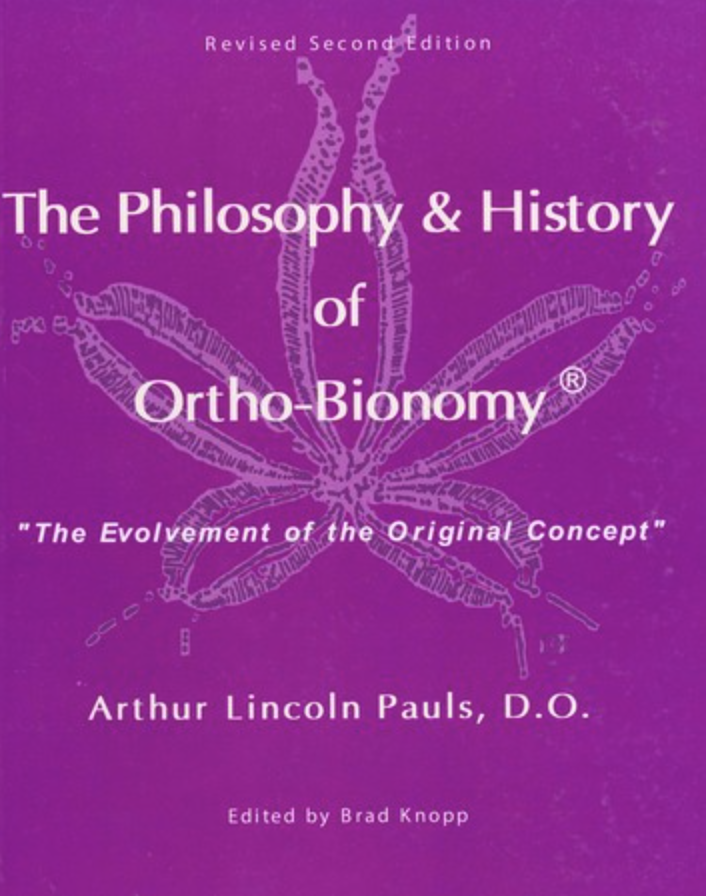
The following is from The Philosophy and History, 2nd edition, Chapter 6, The Seven Phases, pages 44-46:
Phase 5 becomes difficult because we have been taught to do! do!do!. To be a pure observer is the hardest thing for a human to do. For this is where it all evolves from—doing No- thing!
We touch the body, still hands on, we watch, but we do nothing, and by doing nothing everything can happen. Again, doing nothing cannot be an intention; we are a pure observer. “Ortho-Bionomists do nothing better,” as someone once observed.
In Phase Five we observe, calmly and with no fear! Only then can we feel the REAL movement, not only within ourselves, but also within the other self we are with. Doing! Doing! Doin! leaves no space for listening. When all you are doing fails, allow Phase Five to do you instead.
Here is a wonderful tale about a dying racehorse. A French veterinary surgeon was hired to put down the suffering animal. While we were awaiting the vet's arrival, one of my teachers put one hand on the horse's belly where the colon was totally blocked, placed the other hand on its back, and listened to the Phase Five story. About 20 minutes later, the colon moved. The vet arrived and stated that there is now no need to put down the horse, which made a full recovery and began racing again.
In a related stor: I was called to look at a pregnant horse previously hurt in a hurdle race, ending its career. As I worked with Phase Seven, the horse told me the story of falling, which was confirmed by the horse's trainer. I touched a place on the injured horse's neck. The horse turned at the Phase Five angle for correction. I also observed a low left ilium; I stood beside her and touched the flank of the leg and the hip joint. She slowly lifted the leg as Phase Five took over. Two days later the horse gave birth to a male foal and future racehorse! The mother also was able to return to the racetrack.
A few weeks later, the same Ortho-Bionomy teacher who called me in for the hurt horse near Strasbourg, was called to come home by her husband because a client was waiting for her. She arrived at home in her little village to find, right there in her front yard, a horse who had been told by another horse that he could be helped by her. He had broken loose from his stall and trotted to her place! The stables of these harness-racing horses are in the same village where she lives.I used to believe that horses were stupid animals! After I observed these amazing events, I realized how very wrong I'd been.
One more horse tale: I was recently in Italy near Milan to do a seminar on Phase Seven. Two students of Ortho-Bionomy, a medical doctor and his wife, came to visit me. The doctor told me the story of how he had helped a racehorse that had fallen in a jump over a fence, which resulted in the horse's neck locking up. He used Phase Five to start it moving again and Phase Four to correct it. Ortho-Bionomy saved another horse's life. Any vets reading this? Ortho-Bionomy would be very beneficial for veterinary surgeons to learn; it could spare an endless number of animals from unnecessary suffering. So far no interest, but I have patience.
One way to do Phase Five: Turn towards a Phase Four, then let it turn itself into a Phase Five. You will know when it happens because it will let you know! Surrender to the feeling!
Real wisdom leaves no space for belief!
In our unwise state, we attempt to create a place for belief. Drop the belief to allow wisdom in Phase Five to appear where it has always been—within us.
All the Phase Four reflexes, of which there are 7, can become different Phases by their own self-understanding. The only difference is that we start the reflex off and watch it to its logical or illogical conclusion, according to which handicap is the attachment.
Here is a wonderful Phase 5 story: In an Ortho-Bionomy class, a man tells us about his “accident” of how he crushed a bone in his foot. To replace the part, a piece of his own hip bone was used and shaped as best as science could provide. He had pain when walking. For 10 years. All Phase Four moves failed. To change the condition, I did a demonstration of Phase Five on his foot. Ten minutes of listening to the foot, reveals a failure on the part of the piece of hip bone to adapt to being in a different part of the man's body. The man then stood up and walked without pain, and still does to this date, over three years later.
What happened? I do not know, but IT knows!
I have so many stories of this type in all the Phases, enough to fill several books. Besides, telling stories is telling stories. We will believe what we want to, according to our involvement in the handicaps I have previously mentioned. To quote the old proverb: “A man convinced against his will [belief] is of the same opinion [belief] still.”
 Print
Print 