Care of Self Meets Care of Other
(and How they broke free from the frozen binary and played freely together the game of reciprocating well-being)

For those who need counting:
I count this as a
Phase Five class in the Ortho-Bionomy®
Practitioner Training Programs.
Authority given to me by myself as senior Advanced Instructor
<< New text box >>
<< New text box >>
What is the body schema?
Is it a thing, like a body is a thing?
Is the body actually a thing?
Are you a thing? Am I a thing?
Not at all like a rock is a thing,
Or a chair, a hammer, a book.
Are there degrees of thingness?
A rock is a rock, but a book? Now
That’s something else.
Is a hammer even fully a thing until
it has something to hammer at?
Even the nail isn’t fully what it is
Until it’s driven into wood
Maybe to help make the chair
that is not the thing it is until
it’s sat upon.
And do you not sit upon every chair you see?
You as body schema if not quite yet flesh.
The body schema is how you move without moving.
Your body schema.
Possessive pronoun? Is it “yours” or is it just you?
Move in any way you choose to move and
It’s there before you get there.
Unless you are flung somewhere
—like over a rainbow—
That’s another way to move,
A different flavor of movement.
We are laid down in a matrix of
background cosmic movement.
Heraclitus, Greek God of Movement.
It’s not something one is generally aware of.
Being aware would only get in the way,
Slow things down.
Might go so far as to say it’s a phase of the body.
Going grammatical
(we will be going grammatical
From time to time)
I posit that this BS is the body in a subjunctive mood.
Body schema=body subjunctive,
I.e., the body what-if, the body as-if, the iffing body ( not the effing body).
Might say body schema is a concept
(WTF is a concept? That’s a story too hard to tell here (read Fodor on the concept of the concept if you really get confused).
Devised by neurologists in the nineteen teen years.
How the body keeps track of itself,
Knows the space and the stuff of the phantom called self.
Before I wander on too far, first some basics.
What is an organism? For that matter what is life?
What are the actions of any organism?
What do inner and outer mean?
First though a warning.
The word quantum is a thorn-word.
I coin the term thorn-word.
Words to be very cautious and intentional about using.
(“But” was my first thorn-word to master; I now seldom blurt my buts.)
Many years ago in Fowler’s Dictionary of Modern English Usage I was warned about “borrowed technicalities”. The word quantum falls into this category. Unless you are reading serious physicists or certain philosophers (physics needs more of these) it is likely someone is trying to hoodwink and bamboozle you.
All that Quantum Healing claptrap.
I have done my best to avoid using the word but after reading a few books by quantum physicists and know at least a little about what is meant by the “Copenhagen interpretation” I will cautiously use the word. I would humbly request that certain neurologists and cognitive scientists get together with a select team of quantum physicists and ask some seriously playful questions. How does the body schema weave it all together? What is value and how does valuation move stuff around, change the shape of the world? Somehow, when I read about things like quantum entanglement I see the world. I’m hoping someone will set me right.
Let’s get going.
In the beginning…,
In the time before the invention of beginnings and endings
Who says there has to be a beginning?
Maybe the big bang is just a big burp
Cosmic flatulence.
Once upon a time, in the time before the invention of time, there was a universe with no life, the universe before the invention of life.
Like a child taking a toy apart to see how it works
I ask you to imagine this universe without life.
Just be aware that the very act of imagining such a universe automatically obliterates it.
But set that aside.
Stuff is roiling about.
A higgledy-piggledy hodge-podge of multiverse.
Confront now the great mystery of the origin
(And the extent of)
Life.
What does Life need?
Life organizes stuff (this pun is highly intentional).
To organize it needs
Compartments.
Life first needs an inside
for itself to be in and
it needs an outside or it is nothing
but the sound of one hand clapping
It must define against all the rest of the stuff that it is not.
It is only in relation* that it gains existence.
*This word relation has made its first appearance here and I promise is to have a starring rôle in this story.
Life knows that in order to be it must have boundary.
There must be a barrier that maintains a milieu intérieur holding the within within certain parameters while just on the other side—the out— there is wilder variation.
The cell membrane (many organisms—e.g.,plants, bacteria, fungi—have an added outer cell wall) is a leaky barrier. To be alive means it needs a constant flow trough of specific kinds of stuff.
Now we see we Las have value entering the picture.
Life sorts stuff. Some stuff it recognizes as different to other stuff. It needs this stuff
(but only just so much) and none (well, maybe just a smidgen if it will be fun and different oh wow I know I shouldn’t be ingesting this but give me more of that Lots More…. I’ve slipped beyond the cellular and jetted to the supratentorial).
All this activity comprises a system. An open system, as opposed to a closed system. All closed systems are imaginary; open systems rise to the level of true fiction.
Any organism is located as a system of systems.
A fractalized system, level upon each level and each level mixed in in every other level. Some only in potential.
We now have bubbles. Sloterdijk would maybe have it as a foam. A whipped cream world, a meringue.
Trying to pick up now from a two-day spell away and distraction in the background. And I am thinking I want to lay down here a list of properties of the BS as presented in Wikipedia.
Neuroscientists Patrick Haggard and Daniel Wolpert have identified seven fundamental properties of the body schema. It is
- spatially coded
- modular
- adaptable
- supramodal
- coherent
- interpersonal
- updated with movement
These will be expanded upon as needed. In the meantime, the reader may prepare by reading the Wikipedia entry.

[I am finding myself distracted by the idea of transition zones. I had written a bunch of stuff here that did not save, and when I returned, it was gone. This is not the place for it but this is where it continues to want to be.
How is it that the BS makes matter move? If I had the power, I would organize a team of neurologists, cognitive scientists, and quantum physicists to figure this one out. A blob of organized matter makes in itself a model of itself; then the model moves the matter. It thinks itself into a different shape, a different place, then finds itself there.
It is well worth the time to hang in this transition zone, hit the next key but don't hit the next key, hover between moving and not moving. Feel the apophatic of movement.
One of my favorite words is cleave. It is a kind of word called a contronym; it is one thing and its opposite. These kinds of words are also called Janus words. Hold on to and let go, separate. That is how mucus is (think snail slime), sticky and slippy. Body Schema is psychic mucus.I am not even close to being a quantum physicist (physics was my weakest college course, barely passed) but something like entanglement must be involved here.
Body Schema vs Body Without Organs
I was reading this book, Anti-Oedipus by Deleuze and Guattari, and a phrase they use—“body without organs”—somehow captured my imagination. It wasn't at all clear to me what they meant by it, but I learned it came from Antonin Artaud. I was somewhat familiar with him from my time as a theater arts student, but I hadn't encountered that phrase. Whatever these authors intended the image to do, I started thinking of the body schema as being a body without organs.
Bunter replies:
Oh, there's something to play with here. And I think your proposed substitution—body schema as a body without organs—is more interesting than a superficial resemblance between two mysterious-sounding bodies.
Yes, the phrase body without organs comes from Antonin Artaud, the poet, actor, and theatrical visionary who experienced severe psychiatric illness and prolonged institutionalization. Deleuze and Guattari borrowed it from him, particularly from his 1947 radio work To Have Done with the Judgment of God.
Artaud's phrase was an act of rebellion against the body's organization and subjection, not a proposal for an alternative anatomy.
D&G made something considerably more elaborate of it.
What is a body without organs?
The first trap is taking the phrase literally. A BwO isn't a body from which the organs have been removed. It's a way of thinking about the body before—or outside—the particular organization that assigns each part its identity and function.
For D&G, the distinction isn't primarily between organs and their absence. It's between organs and the organism: the organization that fixes organs into a particular functional hierarchy.
A BwO is not simply an unstructured body, either. It has intensities, differences, capacities, connections. It can be understood as a field of potential arrangements rather than a settled arrangement.
That is why their discussion can sound simultaneously liberating and alarming. Undoing an organization may open possibilities, but it may also destroy the conditions that sustain a living person. D&G themselves warn against reckless attempts to dismantle the organism.
Now, the body schema
Your body schema, as you've been developing it, is not an anatomical diagram or a little homunculus directing the limbs. It's a dynamic organization of bodily possibilities—something that can be experienced through movement, expectation, contact, and the presence of another person.
That suggests several intriguing correspondences.
First, the body schema is not confined to anatomical boundaries. A tool can become incorporated into our practical sense of bodily reach. Another person's movement can enter into our own anticipatory organization. The anatomical body remains where it is, but the possibilities of action change.
Second, organization can change without an anatomical change. This seems particularly important to your account of Phase 5. The practitioner isn't necessarily manipulating a structure. Something changes in the pattern of possibilities, and a movement that wasn't available becomes available.
Third, the body schema is relational. It is not simply an internal picture of the body. It participates in the body's ongoing dealings with its surroundings.
Here is where I see the strongest affinity with the BwO: both invite us to stop treating the anatomically organized organism as the complete account of what a body can do.
D&G's emphasis on connections, intensities, and experimentation is quite explicit.
But there is a difference I wouldn't erase
The body schema is a concept with roots in neurology, psychology, and phenomenology. It helps describe the organization of perception and action.
D&G's BwO is a much broader philosophical construction, involving desire, social organization, subjectivity, and the possibility of escaping established patterns. It's not a neurological hypothesis in disguise.
If you identify the two, you risk losing the useful specificity of both.
But if you borrow the BwO as a perspective on the body schema, something opens up. Imagine the body schema not as a representation of the body's existing organization, but as an ongoing negotiation among possible organizations. The BwO then becomes a way of asking: What can this body do that its present organization does not yet permit?
That strikes me as a very orthobionomic question. And there is a delightful complication. D&G write of the BwO as something you never finally arrive at, but are continually making. That sounds remarkably close to your recent woolgathering about existence as becoming.
One last thought, perhaps the most consequential:
Phase 5 may not be a matter of accessing a more fundamental body beneath the anatomical one. It may be a way of temporarily loosening the body's habitual organization so that another organization can emerge.
That would allow you to retain the spectral body without turning it into a second, invisible organism. I wonder, though, whether your attraction to the BwO lies less in its philosophical machinery than in the extraordinary freedom of the phrase itself. Body without organs makes the familiar body suddenly strange. And sometimes that is enough to let us notice something we've been overlooking.
 Flaneur (Out for a Stroll)
Contact
Richard Valasek 1308 Ala Kapuna St. Apt 103
Honolulu HI 9681
+1 (808) 256-1646
richard.valasek@gmail.com
to e-mail form
I am I and my circumstance;
and, if I do not save it, I do not save myself. —JOSÉ ORTEGA Y GASSET
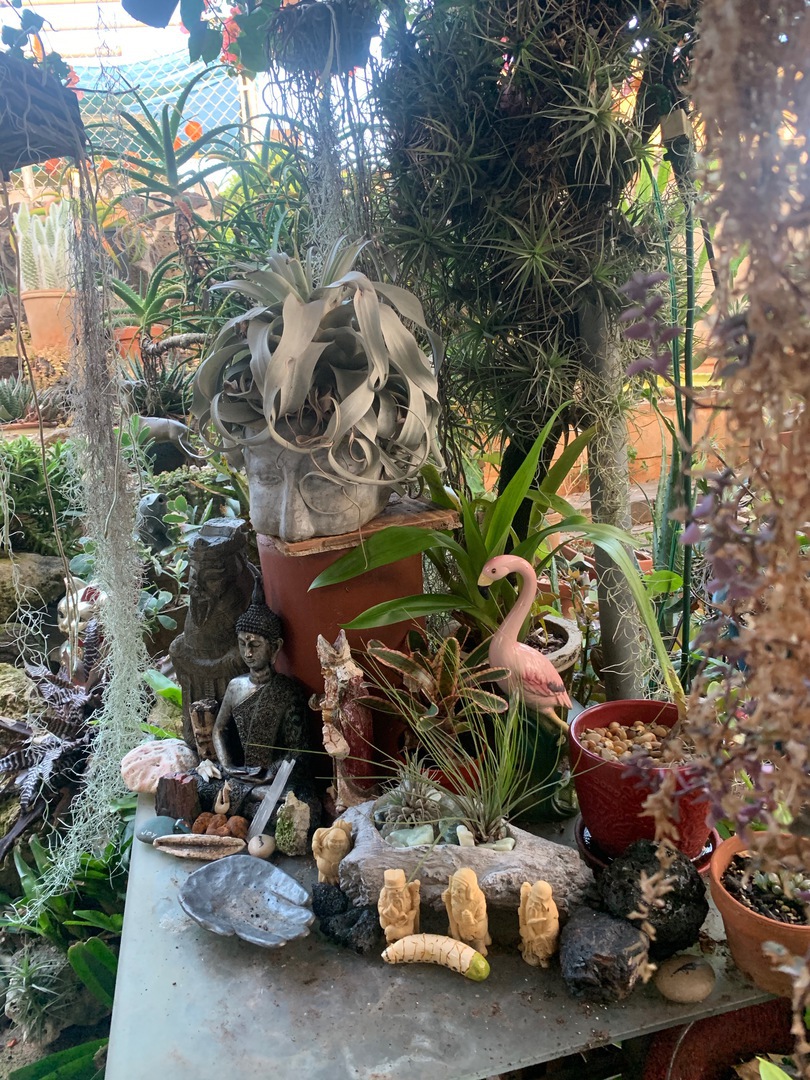 Changing the Conversation
I was born. I am always a vessel for something other than myself. The self is only a
vehicle for Foreign matter which comes from elsewhere and is destined to go on
elsewhere without me, whether it's words, smells, vision ––EMANUELE COCCIA Metamorphoses
 The Story Teller
Now, more than ever . . . our place in the universe and the place of the universe in us, is proving to be one of active relationship. That is more than a scientist's credo. The separateness of our lives is a sham. Physics, mathematics, music, painting, my love for you, my work, the star-dust of my body, the spirit that impels it, my politics, clocks diurnal, time perpetual, the roll, rough, tender, swamping, liberating, breathing, moving, thinking nature, human nature and the cosmos are patterned together.
—JEANETTE WINTERSON Gut Symmetries

What you do, what you become, is not my concern. –ROBERT MCCALL
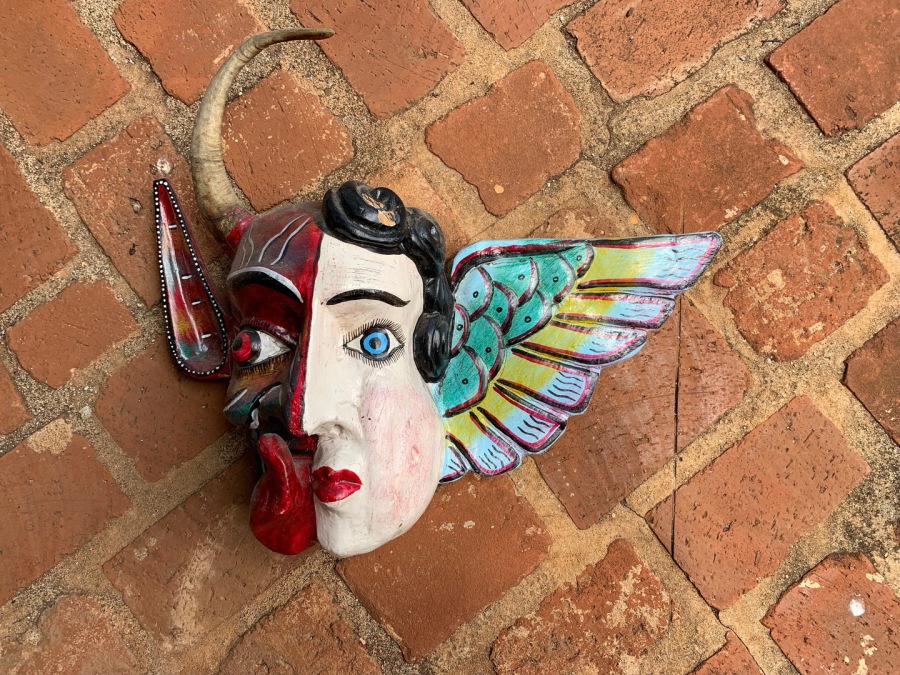 Agathokakological Mexican mask
Yes, there is beauty
There is love
There is joy.
All you who suffer from
the world's miseries
Defend them.
––EEVA KILPI
"Don't immanentize the eschaton."
––ERIC VOEGELIN
For the god of writing is also the god of death. He will punish the imprudent who, in their quest for unlimited knowledge, end up drinking the dissolved book.…To drink the tear and wonder about the strangeness of its taste compared to one's own...
Jean-Marie Benoist,
The Geometry of the Metaphysical Poets
There is no inside except as a folding of the outside. The mirror cracks; I am an other, and I always was.
Mark Fisher,
The Weird and the Uncanny
 Print
